
A local search result rarely gets judged on service quality alone. Before a customer ever calls, books, or walks through the door, they scan a handful of stars, a review count, and a few lines of text, and they form a judgment in seconds. That judgment now happens earlier and carries more weight than most business owners realize.
Google reviews sit at the intersection of two systems that decide whether a business gets chosen: the ranking algorithm that determines visibility, and the human decision-making process that determines trust. Understanding how these systems work together, rather than treating reviews as a background task, helps business owners prioritize review generation with the same seriousness they give to their website or their ad spend. This article breaks down how reviews influence local ranking, how they shape customer psychology, and what a defensible review strategy looks like in practice.
KEY TAKEAWAYS
What the research on reviews actually shows
- Reviews are an official ranking signal. Google reviews function under prominence, one of the three official pillars (relevance, distance, prominence) Google uses to determine local search results.
- Star rating alone does not predict conversion. Independent research from Northwestern University found purchase likelihood peaks between roughly 4.2 and 4.7 stars, not at a perfect 5.0.
- Trust in reviews is now close to universal. BrightLocal’s 2026 survey found 97 percent of consumers read reviews before choosing a local business, and 41 percent say they always do.
- Volume acts as a credibility gate before quality is even considered, with a meaningful share of consumers dismissing businesses that have too few reviews to judge.
- Responding to reviews is both a trust signal and an engagement signal, one that customers notice and one Google associates with an active, legitimate business.
- Fake and incentivized reviews are now a legal liability, not just a reputational risk, under federal regulation that took effect in October 2024.
What Google Reviews Actually Do for a Local Business
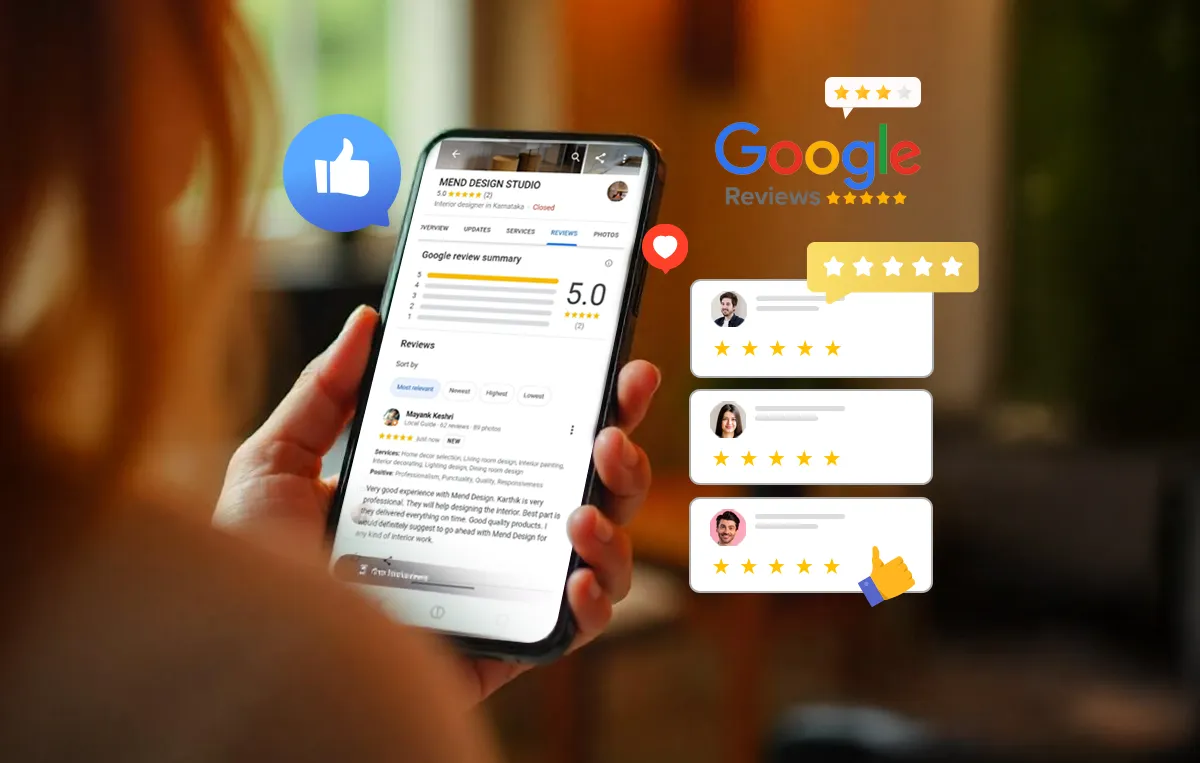
Google reviews are the star ratings and written feedback customers leave directly on a Business Profile, visible in both Google Search and Google Maps. They serve two distinct functions at once: they feed Google’s local ranking algorithm, and they inform the human being deciding whether to trust a business enough to contact it. A business can perform well on one of these functions and poorly on the other, which is why reviews deserve attention as both an SEO input and a conversion input.
Business owners often treat reviews as reputation management, something handled after a bad experience. In practice, reviews function more like ongoing evidence. Each new review adds a fresh, customer-written data point that both Google and prospective customers use to answer the same underlying question: is this business active, real, and worth the risk of choosing?
How Reviews Fit Into Google’s Local Ranking Algorithm
Google states directly that local search results are determined by three factors: relevance, distance, and prominence. Reviews sit inside prominence, which Google describes as how well-known a business is, based partly on how many websites link to a business and how many reviews it has, with more reviews and positive ratings supporting local ranking. This is not a third-party interpretation. It comes directly from Google Business Profile’s own help documentation.
| Ranking Factor | What It Measures | Role of Reviews |
|---|---|---|
| Relevance | How well a Business Profile matches the search query | Review text can reinforce service and category relevance through natural language |
| Distance | Physical proximity to the searcher | Not directly affected by reviews |
| Prominence | How well-known and trusted the business appears | Directly influenced by review volume, rating, and recency |
Prominence is the factor businesses have the most room to influence without competing on location alone. A business a few miles farther from the searcher can still outperform a closer competitor if its prominence signals, including its review profile, are stronger. This is also why review recency matters: a steady stream of new reviews signals an active, currently operating business rather than one that opened once and stopped engaging.
Why Star Rating Alone Does Not Tell the Whole Story
A near-perfect star rating sounds like the goal, but the research does not support that assumption. Northwestern University’s Spiegel Research Center analyzed reviews across dozens of product and service categories and found that purchase likelihood typically peaks at ratings in the 4.0 to 4.7 range, then begins to decrease as ratings approach 5.0. Consumers tend to read a flawless rating as evidence that something has been filtered or manufactured, not as proof of consistent quality.
THE “TOO GOOD TO BE TRUE” EFFECT
Purchase likelihood peaks at 4.0–4.7 stars, not 5.0
A review profile with mostly strong ratings and a small number of critical ones tends to read as more credible than one with nothing but five stars.
SOURCE · Northwestern University, Medill Spiegel Research Center
This does not mean negative reviews are good news. It means a review profile with mostly strong ratings and a small number of critical ones tends to read as more credible than one with nothing but five stars. A dental practice with 4.4 stars across 150 reviews, including a handful of three-star experiences the practice responded to thoughtfully, is likely to earn more trust than a competitor showing a suspiciously perfect 5.0 across only twelve reviews.
The Trust Signal: How Reviews Shape Decisions Before a Customer Ever Calls
Reading reviews has moved from a habit to a near-default behavior. BrightLocal’s 2026 Local Consumer Review Survey, based on a representative panel of 1,002 US adults, found that 97 percent of consumers read online reviews before choosing a local business, and 41 percent now say they always do, up sharply from 29 percent the year before. The same research found that 68 percent of consumers require a minimum of 4 stars before they will consider a business, and 31 percent will only use a business rated 4.5 stars or higher.
REVIEW VOLUME AS A CREDIBILITY GATE
47% won’t consider a business with fewer than 20 reviews
Volume acts as a separate filter from rating. A five-star rating built on three reviews reads as an unproven sample size, not a guarantee of quality.
The commercial impact of clearing that check is substantial. BrightLocal’s research also found that 85 percent of consumers say positive reviews make them more likely to use a business, while 77 percent say negative reviews make them less likely to, and 93 percent report having made a purchase after reading reviews. Reviews are not a supporting detail in the customer journey. For most local businesses, they are the first real evaluation a prospective customer performs.
A Useful Way to Think About Review Impact: digiAURA’s Trust-Visibility Loop
digiAURA frames review activity as a two-directional loop rather than a single metric to optimize. New reviews strengthen prominence, which improves visibility in local search and Maps results. Improved visibility exposes the business to more potential customers, who then read the existing reviews and decide whether to convert, generating more reviews if the experience holds up.
DIGIAURA FRAMEWORK
The Trust-Visibility Loop
New Reviews → Stronger Prominence → Better Visibility → More Prospects Read Reviews → More Conversions → New Reviews
This framing matters because it explains why review neglect compounds over time. A business that stops actively requesting reviews does not just plateau. Its review profile ages while competitors’ profiles stay fresh, which weakens both the ranking signal and the trust signal simultaneously, and the two failures reinforce each other in a downward direction.
What Happens When Businesses Ignore or Manipulate Reviews
Ignoring negative reviews carries a real cost. Consumers do not expect perfection, but they do expect acknowledgment, and a pattern of unanswered critical reviews reads as a business that either does not notice or does not care. Google has also confirmed that responding to reviews shows customers that a business values their feedback, and that positive reviews paired with helpful replies can help a business stand out, tying response behavior to visibility as well as reputation.
Manufacturing reviews is a different and more serious risk. The Federal Trade Commission’s Rule on the Use of Consumer Reviews and Testimonials went into effect in October 2024 and prohibits businesses from creating, buying, or incentivizing reviews that misrepresent a reviewer’s identity or experience, with civil penalties reaching tens of thousands of dollars per violation. Consumers have taken notice of this shift as well: recent BrightLocal research found that the overwhelming majority of consumers want real consequences for businesses caught using fake reviews. Authentic review generation is no longer just a best practice. It is a compliance requirement with enforcement behind it.
 A Practical Example
Consider two HVAC companies operating in the same metro area, offering comparable pricing and both holding valid licenses. Company A has 210 reviews averaging 4.3 stars, with recent reviews mentioning specific technicians and job types, and thoughtful replies to its handful of one and two-star reviews. Company B has 40 reviews averaging 4.9 stars, most posted more than a year ago, with no owner responses visible.
SAME MARKET. DIFFERENT REVIEW PROFILE.
210 reviews at 4.3 stars vs. 40 reviews at 4.9 stars
A homeowner comparing both listings after a broken air conditioner in July is likely to call the business with more, fresher, answered reviews first, not the one with the higher star average.
ILLUSTRATIVE EXAMPLE · NOT AN INDUSTRY BENCHMARK
A homeowner comparing both listings after a broken air conditioner in July is likely to call Company A first, not because the rating is higher, but because the volume, recency, and response pattern read as more credible. This is a hypothetical scenario meant to illustrate the mechanism, not a documented outcome from any specific client engagement.
How to Build a Review Strategy That Supports Local SEO
A defensible review strategy treats collection, response, and monitoring as ongoing operational tasks rather than a one-time project.
- Ask consistently, not occasionally. Build a review request into the natural end of a service interaction rather than relying on customers to think of it themselves.
- Respond to every review, positive and negative. A brief, specific, professional reply does more for trust than a longer generic one.
- Never incentivize sentiment. Compensation or rewards tied to leaving a positive review violates FTC rules and undermines the authenticity that makes reviews persuasive in the first place.
- Monitor recency, not just average rating. A profile that stops accumulating reviews starts to look inactive to both Google and customers, even if the historical rating is strong.
- Treat review text as content. Encourage detailed feedback naturally; specific language about services and outcomes reinforces relevance for the searches that actually matter to the business.
Frequently Asked Questions
Do more Google reviews always mean a better local ranking?
Not automatically. Review volume supports the prominence factor in Google’s algorithm, but relevance and distance also matter, and a business with strong reviews and weak profile information may still underperform a well-optimized competitor.
Is a 5.0 star rating actually a disadvantage?
It is not a disadvantage on its own, but research suggests it can trigger skepticism, particularly with a small review count. A strong rating in the low-to-mid 4-star range paired with a healthy review volume tends to convert better than a small sample of perfect scores.
How many reviews does a local business need to be taken seriously?
There is no official Google minimum, but consumer research indicates a meaningful share of shoppers dismiss businesses with fewer than 20 reviews. Competitive local markets often require more.
Should a business respond to negative reviews publicly?
Yes. A calm, specific, professional response shows both the reviewer and future readers that the business takes feedback seriously, and Google has confirmed that responding to reviews supports visibility as well as reputation.
Is it legal to offer a discount in exchange for a review?
No. FTC rules prohibit compensation or incentives tied to reviews expressing a particular sentiment, whether the request is explicit or implied. Businesses can ask for honest feedback but cannot pay for positive reviews.
Can old reviews hurt a business even if the rating stays high?
Yes, in effect. A stagnant review profile signals reduced recent activity to both Google’s ranking system and to customers who prioritize recency when judging trustworthiness.
Do reviews matter as much for B2B or service-area businesses without a storefront?
Yes. Prominence and trust signals apply regardless of whether customers visit a physical location, and service-area businesses often depend even more heavily on reviews since customers cannot walk in to assess quality directly.
GET FOUND
Build a Stronger Local Reputation
Understanding how reviews influence ranking and trust is the easy part. Building a consistent system that generates authentic reviews, responds to them promptly, and keeps a profile active month over month is where most businesses lose momentum. The digiAURA Get Found System connects local SEO, review generation, and Google Business Profile management into one coordinated strategy so visibility and reputation grow together instead of competing for attention.